Confirm balloon position and function from the console
Procedure AC3 · post-insertion-console-checks
Overview
What the AC3 Optimus™ can and cannot tell the clinician about where the intra-aortic balloon (IAB) sits. Final position is confirmed by imaging per the IAB Instructions for Use and institutional protocol; the console's contribution is the balloon pressure waveform (BPW), the augmented pressure, and three alarms whose listed causes include a mispositioned or sheathed balloon.
When to perform
In the first minutes after starting counterpulsation, and again after any patient repositioning or transfer.
Equipment
- Cursor key (to read plateau and AUG values)
Controls involved
- Cursor (touchscreen)1
- Places a measurement line on the AP and BPW traces and shows their mmHg values, used to compare plateau with augmented pressure.
- Alarm message area / corner switch2
- HIGH PRESSURE, HIGH BASELINE and reduced-augmentation findings are where position problems surface; the corner switch silences the tone but leaves the message to be read.
Steps
Read the balloon pressure waveform shape: a flat plateau with a small fill overshoot and deflation undershoot and a baseline near zero means the balloon is opening and emptying freely.3,4
Every abnormal shape is a departure from these four parts, and the first three positional problems all distort the plateau.
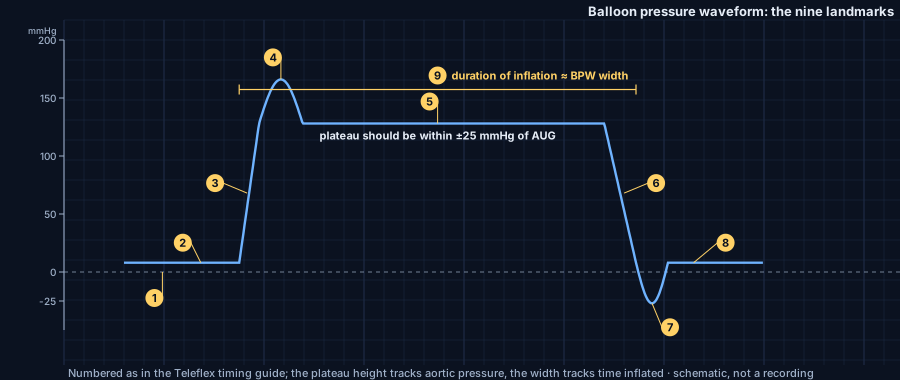
The nine landmarks; plateau within ±25 mmHg of AUG, width ≈ time inflated 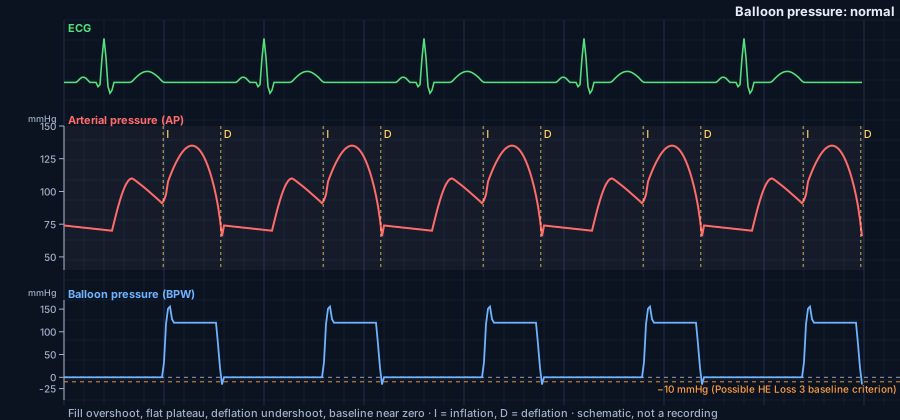
Normal balloon pressure waveform: fill overshoot, flat plateau, deflation undershoot, baseline near zero Place the cursor on the plateau and compare it with the augmented pressure (AUG): they should agree within 25 mmHg.1
Inside the aorta the balloon's internal pressure equals the blood pressure around it; a plateau well above AUG means the balloon is being squeezed — too large, kinked, sheathed, or sitting where the aorta is narrow.
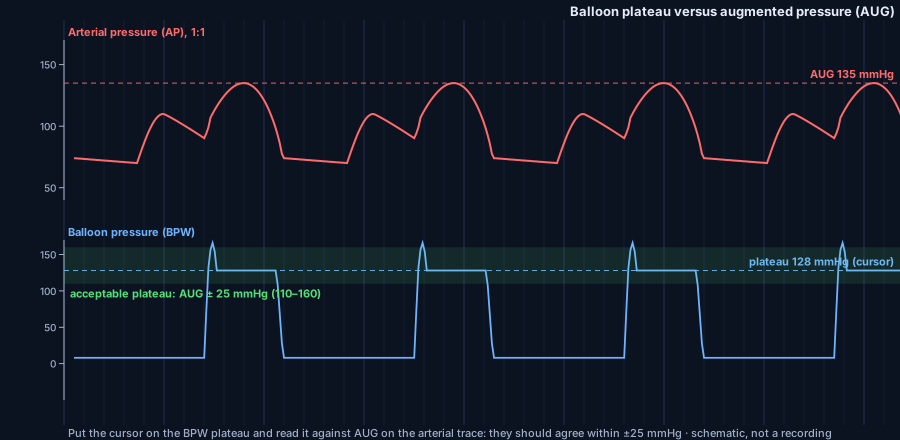
Cursor on the plateau, read against AUG: agreement within ±25 mmHg means the full balloon is feeling the pressure it is supposed to raise If AUG is much lower than the patient's own systolic pressure while plateau and AUG agree, suspect a balloon that is too small or not correctly positioned and check position (and reposition per protocol) before changing anything on the console.1
A well-fitting, free balloon in the wrong place still displaces little blood.
Treat a HIGH PRESSURE alarm that persists after the unwrap period as a position/mechanical finding: kink, not fully exited sheath (especially sheaths longer than 15 cm), too high, too low, or too large.5
These are the manual's listed causes; the alarm criterion is a plateau above 250 mmHg for 5 consecutive or 10 of the last 20 beats.
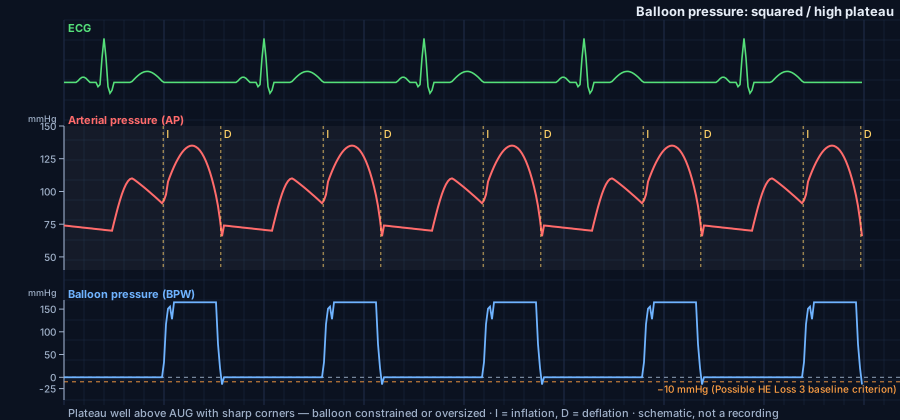
Squared-off plateau without the fill overshoot: gas is not moving freely — balloon not fully unwrapped, kinked, or positioned against the wall Treat a HIGH BASELINE alarm (BPW above 25 mmHg during deflation) the same way, and if the balloon may be partly inflated, disconnect the connector and aspirate the IAB with a 60 cc slip-tip syringe.6
Gas that cannot leave the balloon means an obstruction to deflation; a partly inflated balloon left in place risks thrombus and obstructs ejection.
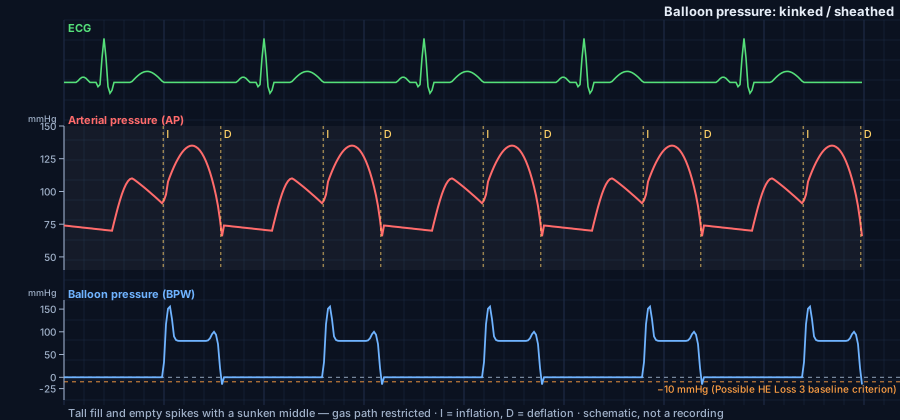
Balloon pressure: kinked / sheathed — Tall fill and empty spikes with a sunken middle — gas path restricted Confirm final position by the imaging your protocol requires, then re-check the console findings after any move of the patient.7
The console reports consequences of malposition, not position itself; moving a patient can kink the catheter or draw the balloon back into the sheath.
Cautions
- If the balloon pressure waveform does not resemble a normal or acceptable waveform, take immediate action to correct a potentially unsafe condition.8
- If an IAB is suspected of being occlusive, do not reduce volume below 2/3 (66%) of capacity; consider a smaller IAB.9
Related knowledge
- HIGH PRESSURE criteria and causes (AL-016)
- HIGH PRESSURE at initial start-up (AL-017)
- BPW plateau versus AUG (TS-019)
- Three causes of a squared BPW (TS-020)
- Reduced augmentation: low plateau (TS-023)
- Nine landmarks of the balloon pressure waveform (TS-027)
- Balloon pressure waveform troubleshooting at a glance (TS-028)
- Normal balloon pressure waveform characteristics (TT-029)
- Balloon sizing by AUG versus BPW plateau (TT-030)
- The normal balloon pressure waveform (WV-006)
- Squared or high-plateau balloon pressure waveform (WV-007)
- Kinked or sheathed balloon pressure waveform (WV-009)
References
- Arrow International Inc. AC3™ Series IABP System Service Manual. Part No. IAM-9011, Rev 00. Reading, PA: Arrow International Inc (Teleflex); 2015. p 136.
- Arrow International Inc. AC3™ Series IABP System Service Manual. Part No. IAM-9011, Rev 00. Reading, PA: Arrow International Inc (Teleflex); 2015. pp 191-192.
- Arrow International Inc. AC3™ Series IABP System Service Manual. Part No. IAM-9011, Rev 00. Reading, PA: Arrow International Inc (Teleflex); 2015. pp 134-135.
- Teleflex Inc. Arrow Intra-Aortic Balloon Pump Series: Timing Guidelines [trifold]. MC-004848 Rev 1. Wayne, PA: Teleflex Inc; December 2019. p 1.
- Arrow International Inc. AC3™ Series IABP System Service Manual. Part No. IAM-9011, Rev 00. Reading, PA: Arrow International Inc (Teleflex); 2015. p 191.
- Arrow International Inc. AC3™ Series IABP System Service Manual. Part No. IAM-9011, Rev 00. Reading, PA: Arrow International Inc (Teleflex); 2015. p 192.
- Arrow International Inc. AC3™ Series IABP System Service Manual. Part No. IAM-9011, Rev 00. Reading, PA: Arrow International Inc (Teleflex); 2015. pp 226-227.
- Teleflex Inc. Arrow AC3 Safety Information: indications, contraindications, warnings, cautions, adverse events. Teleflex Interventional website. Updated April 20, 2023. Accessed October 23, 2026. Warning 32.
- Teleflex Inc. Arrow AC3 Safety Information: indications, contraindications, warnings, cautions, adverse events. Teleflex Interventional website. Updated April 20, 2023. Accessed October 23, 2026. Warning 33.
- Teleflex Inc. Arrow Intra-Aortic Balloon Pump Series: Timing Guidelines [trifold]. MC-004848 Rev 1. Wayne, PA: Teleflex Inc; December 2019. pp 1-2.